Book your trip from Fort-de-France

Departure
Martinique Aimé Césaire (FDF)
Arrival
To...
Dates
Dates of your trip
Travellers
1 adult
Round-trip flightsOne-wayMulti-city

The destinations

Top deals from Fort-de-France

Fort-de-France - Saint-Martin-Marigot
Departure 18-01-2027
Return 31-01-2027
Return
From
259 €
Fort-de-France - Cayenne
Departure 24-11-2026
Return 28-11-2026
Return
From
473 €
Fort-de-France - Paris
Departure 09-11-2026
Return 07-12-2026
Return
From
554 €

The Martinique Aimé Césaire network

Show all Air CanadaAir FranceAmerican AirlinesCorsairAir TransatAir CaraibesCaribbean AirlinesCondor
Show all CaribbeanEastern EuropeNorth AmericaSouth AmericaWestern Europe
Show all
and more
and more
and more
and more
CanadaCanadaNew
3 destinations 2 airlinesCountry info
FranceFrance
2 destinations 3 airlinesCountry info
French GuianaFrench Guiana
1 destination 1 airlineCountry info
United StatesUnited States
1 destination 1 airlineCountry info
The Guadeloupe IslandsThe Guadeloupe Islands
1 destination 2 airlinesCountry info
Saint MartinSaint Martin
1 destination 1 airlineCountry info
BarbadosBarbados
1 destination 1 airlineCountry info
GermanyGermany
1 destination 1 airlineCountry info
Trinidad and TobagoTrinidad and Tobago
1 destination 1 airlineCountry info
Saint LuciaSaint Lucia
1 destination 1 airlineCountry info

Getting to Martinique Aimé Césaire airport

Access from the motorway

From the A1 motorway, follow the signs for Aéroport international Martinique Aimé Césaire and Le Lamentin. Access is via the Le Lamentin area, in the immediate vicinity of the airport terminal. Coming from Fort-de-France, stay on the A1 towards Le Lamentin, then follow the airport signs. Coming from the south of the island via the RN5, join the A1 towards Fort-de-France and head towards the airport as soon as you see signs for Le Lamentin and the terminal. The airport entrance is clearly signposted over the final few kilometres.

Access from a national road or the town centre

From the centre of Fort-de-France, join the A1 towards Le Lamentin, then follow the signs for Aéroport international Martinique Aimé Césaire. From Le Lamentin, take the local roads towards the airport, located in the Californie area, south of the town centre. From the RN5, head towards Le Lamentin, then follow the signs for the airport. From the municipalities in the centre or east of the island, first head to Le Lamentin, then follow the signs to the terminal. The main landmark is the airport’s immediate proximity to the Le Lamentin urban area and the A1 express route.

All the services you might need

Hire a car at Martinique Aimé Césaire airport

Choose from our partner rental agencies at the airport and set off with peace of mind.

Hire a car at Martinique Aimé Césaire airport

Centre for car hire companies

The airport Martinique Aimé Césaire

Located 12 km from Fort-de-France in the commune of Le Lamentin, Martinique-Aimé Césaire International Airport is the second airport in the West Indies, after Guadeloupe-Pôle Caraïbes. The airport handles an average of 1,750,000 travellers each year. Thanks to the airlines operating there, regular air connections to the Caribbean, the Americas and Europe are available from the airport. Covering an area of 28,000 m², the passenger terminal consists of a fully air-conditioned building with a spacious 2,500 m² check-in hall. The airport also has a fully equipped business centre and an outdoor car park with more than 1,600 spaces. In terms of services, passengers have access to a pharmacy, a medical centre, a currency exchange office and several ATMs.

See all destinations

FAQ

What is the name of Fort-de-France airport?

Which airlines operate at Fort-de-France airport?

How to get from the city centre of Fort-de-France to the airport?

News from Martinique Aimé Césaire Airport

Air Canada launches new Fort-de-France–Quebec City flight

Martinique Aimé Césaire Airport’s environmental approach

Sustainability initiatives Martinique Aimé Césaire
4.5/5
An environmentally responsible airport

An airport whose environmental approach, validated by recognised international programmes, constitutes the most advanced strategy for an airport to achieve carbon neutrality.

Assessment based on information provided by the airport

Airport Carbon Accreditation (ACA) label

Airport Carbon Accreditation (ACA) is a global certification programme for airports, recognised by international air transport bodies. It assesses and certifies airports’ efforts to manage and reduce their carbon emissions across seven accreditation levels. Its aim is to provide a common framework for active carbon management and enable the airport industry to reduce its energy consumption.

Martinique Aimé Césaire Airport is accredited at Level 3.

Aéro biodiversité label

Founded in 2015, the Aéro Biodiversité association identifies, protects and promotes the biodiversity found in green spaces around airports. The Aéro Biodiversité label aims to protect the fauna and flora of this ecosystem through a scientific and participatory approach involving all airport stakeholders.

Martinique Aimé Césaire Airport has been awarded the Aéro Biodiversité label.

Actions to preserve biodiversity

The green spaces around runways are home to a variety of animal and plant species, often specific to the area. Airports take a number of measures to limit the impact of their activities on the surrounding biodiversity.

The airport is located within the Regional Natural Park. It ensures the survival of rare natural habitats by maintaining the mangroves and meadows. By preserving this ecosystem of wetlands and canals, the airport provides a vital refuge for the island's biodiversity, from birds of prey to migratory birds.

Alternative energy supply

Airports can decarbonise their operations through alternative energy sources by electrifying airside equipment and ground vehicles, providing charging points so that airlines with aircraft on the ground can avoid using the APU (auxiliary power unit), or supplying sustainable aviation fuels (SAF) to those airlines.

Major providers on the platform, such as Samsic Assistance, have deployed an all-electric fleet (handling equipment, baggage conveyors, tugs) for ground operations.

Responsible natural resource management policy

Airports can limit their direct emissions by optimising their management of the natural resources (such as water, electricity and gas) used to run the airport infrastructure.

Martinique Aimé Césaire Airport does not have a policy for the responsible management of natural resources or does not provide information about it.

Waste sorting and recycling policy

Airports can improve the management of the waste generated by their activities by introducing a policy for sorting and recycling non-hazardous waste (cigarette butts, travellers’ waste) and hazardous waste (engine oil, various pollutants from aircraft).

The airport is taking action for the environment by installing numerous waste-sorting stations and recycling plastic bottles locally for road construction. It is also committed to eliminating single-use plastic in its shops and strictly managing waste from its construction sites to prevent soil pollution.

Installation of solar panels

By installing solar panels, airports can supply themselves with sustainable electricity and optimise the use of their infrastructure.

The airport has a large photovoltaic installation, notably on the canopies of Parking facilities and on some technical buildings.

Development of airport access facilities

Depending on the size of the airport, direct links with the city centre may be developed to optimise passenger flows and reduce car use.

The airport is easily accessible via a network of fuel-efficient hybrid buses. It has also introduced shared shuttle services or minibuses that can accommodate between 8 and 15 passengers..

Other environmental initiatives

Other eco-programmes refer to any other environmental action that the airport implements on its own initiative.

For the 2021-2025 period, Martinique Aimé Césaire Airport entered into an agreement with Madininair, the air-quality monitoring organization in Martinique. The agreement enables monitoring of atmospheric pollutant concentrations and verification that air-quality standards are being met at the airport and in its surrounding area. 

Annual passenger numbers

An airport’s environmental footprint is proportional to its passenger traffic, as are the measures it can take to reduce it. The Airports & Travel Eco-criterion therefore takes this factor into account.

1 875 392 passengers passed through Martinique Aimé Césaire Airport in 2025.
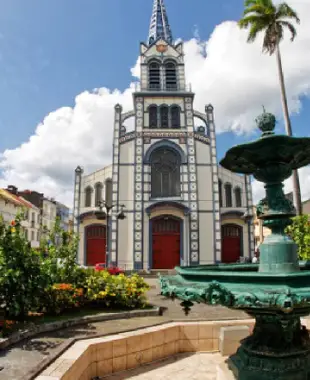
Visit Fort-de-France and its surroundings

Visit Fort-de-France and its surroundings

A Caribbean city whose name evokes sunshine, fine sand and exoticism, Fort-de-France is Martinique's largest city. Book a flight for your trip to Fort-de-France and enjoy scuba diving, jet-ski excursions, cruises or swimming. These are enjoyable activities in the Caribbean Sea. On Madinina, green tourism is also thriving: walks along the coast, canyoning, exploring the heart of the island by 4x4 or on horseback. By boat, the islets of Oscar and Thierry, and farther afield Dominica or Saint Lucia, offer enticing getaways. The Schoelcher Library, a listed landmark with thousands of volumes, is one of Fort-de-France's must-see attractions, along with a stroll through La Savane park or the large covered markets. You can book a nearby hotel room in Fort-de-France right now. Exotic and lively, the markets offer a complete change of scene and allow tourists to stock up on spices or rum during their holidays. It is worth remembering that rum is the island's speciality: a Ti ‘punch or a planteur with your feet in the water—that's paradise!