

Book your trip from Pau

Departure
Pau Pyrénées (PUF)
Arrival
To...
Dates
Dates of your trip
Travellers
1 adult
Round-trip flightsOne-wayMulti-city

The destinations

Top deals from Pau

Pau - Paris
Departure 20-11-2026
Return 24-11-2026
Return
From
199 €
Pau - London
Departure 05-12-2026
Return 12-12-2026
Return
From
246 €
Pau - Rome
Departure 09-01-2027
Return 15-01-2027
Return
From
299 €

The Pau Pyrénées network

Show all Air FranceTwin JetAmélia
Show all Western Europe
Show all
and more
and more
and more
and more
FranceFrance
2 destinations 3 airlinesCountry info
PAR
Paris
M
T
W
T
F
S
S
≃ 13 flights/week
LYS
Lyon
M
T
W
T
F
S
S
≃ 4 flights/week

Getting to Pau Pyrénées airport

Directions to Pau airport

Rte de l'Aéroport 64230 ARBUS, France

Latitude 43.380001068115234 | Longitude -0.4186109900474548

All the services you might need

Book accommodation near Pau Pyrénées airport

Sleep as close as possible to your Terminal and travel with peace of mind.

Book accommodation near Pau Pyrénées airport

Hire a car at Pau Pyrénées airport

Choose from our partner rental agencies at the airport and set off with peace of mind.

Hire a car at Pau Pyrénées airport

Centre for car hire companies

The airport Pau Pyrénées

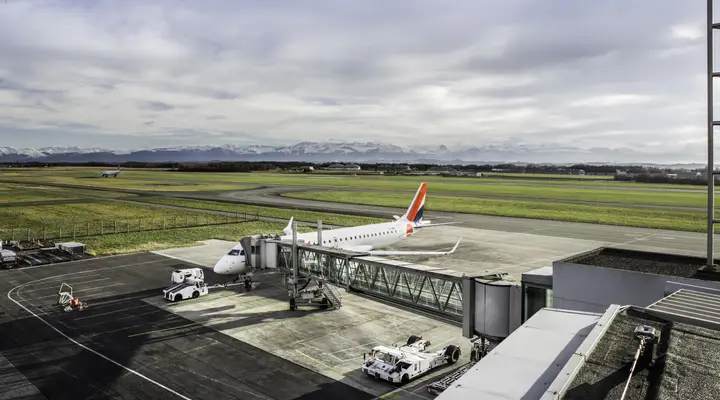
Pau-Pyrénées Airport welcomed 268,647 passengers in 2024. Located in the third economic hub of the Greater Southwest, in the heart of Aquitaine, Pau Pyrénées Airport is a gateway to an entire region encompassing southern Landes, southwestern Gers, Bigorre and, of course, Béarn. Equipped with an all-weather landing system (ATT), the airport is located at the heart of an activity zone combining civil activities (industrial and service-based) with military operations. Pau Airport primarily serves business travellers connected with the region’s major companies, while also welcoming leisure travellers.

Amélia operates 1 to 2 daily flights to Paris Orly. Air France operates 3 to 4 daily flights to Paris Charles-de-Gaulle. To Lyon, Twin Jet operates 2 to 3 daily flights from Monday to Friday. Finally, the airline Chalair operates seasonal flights every Saturday in July and August to Ajaccio, Brest and Kerry.

Just 40 minutes from Lourdes, between the sea and the mountains, and 1 hour from the Pyrenees ski resorts as well as the beaches of the Basque Country and Landes, the airport offers access to a region brimming with activities, events (often sporting), festivities, natural and cultural treasures, and a heritage rich in history and symbolism, not to mention renowned cuisine... Welcome to Pau Pyrénées!

See all destinations

FAQ

Which airlines operate at Pau Airport?

How do I get from Pau Airport to the city centre?

What time does the Pau terminal open?

What parking options are available at Pau Airport?

How do I get to Pau city centre from the airport?

Can I eat or shop in the terminal?

What direct destinations are available from Pau?

News from Pau Pyrénées Airport

Cheap flights from Pau to Paris

Pau-Paris flights: two airlines in the running to operate the future shared air connection to Orly

Pau-Pyrénées Airport is set to gain an air connection to Paris Orly operated under a traffic-sharing arrangement, with two airlines in the running to operate this strategic route from next season.

Read more
Biodiversity at Pau Airport

Pau Pyrénées Airport committed to an Eco-friendly approach

A regional airport (fewer than 500,000 passengers annually), Pau Pyrénées Airport contributes, in its own way, to reducing its environmental footprint and thus to decarbonising the aviation sector.

Read more

Pau Pyrénées Airport’s environmental approach

Sustainability initiatives Pau Pyrénées
4.4/5
An environmentally responsible airport

An airport whose environmental approach, validated by recognised international programmes, constitutes the most advanced strategy for an airport to achieve carbon neutrality.

Assessment based on information provided by the airport

Airport Carbon Accreditation (ACA) label

Airport Carbon Accreditation (ACA) is a global certification programme for airports, recognised by international air transport bodies. It assesses and certifies airports’ efforts to manage and reduce their carbon emissions across seven accreditation levels. Its aim is to provide a common framework for active carbon management and enable the airport industry to reduce its energy consumption.

Pau Pyrénées Airport is accredited at Level 3.

Aéro biodiversité label

Founded in 2015, the Aéro Biodiversité association identifies, protects and promotes the biodiversity found in green spaces around airports. The Aéro Biodiversité label aims to protect the fauna and flora of this ecosystem through a scientific and participatory approach involving all airport stakeholders.

Pau Pyrénées Airport has been awarded the Aéro Biodiversité label.

Actions to preserve biodiversity

The green spaces around runways are home to a variety of animal and plant species, often specific to the area. Airports take a number of measures to limit the impact of their activities on the surrounding biodiversity.

The Pau airport uses non-harmful deterrence techniques and natural treatments to preserve biodiversity. It has implemented a tailored mowing plan with differentiated management and late mowing, and created refuge areas to support biodiversity.

Alternative energy supply

Airports can decarbonise their operations through alternative energy sources by electrifying airside equipment and ground vehicles, providing charging points so that airlines with aircraft on the ground can avoid using the APU (auxiliary power unit), or supplying sustainable aviation fuels (SAF) to those airlines.

The Pau Pyrénées airport electrifies its vehicles and airside equipment, and is considering alternative fuels for the rest of its equipment. It also provides electricity to airlines to avoid using APUs (auxiliary power units providing air and electricity) via electrified GPUs. To reduce CO2 emissions, the airport uses biogas for its gas supply.

Responsible natural resource management policy

Airports can limit their direct emissions by optimising their management of the natural resources (such as water, electricity and gas) used to run the airport infrastructure.

Pau Pyrénées Airport adopts responsible water management with storage, separation, and measurement devices for rainwater. It has also implemented an energy-saving plan by replacing lighting with LEDs, improving thermal insulation, and modernizing heating and ventilation systems.

Waste sorting and recycling policy

Airports can improve the management of the waste generated by their activities by introducing a policy for sorting and recycling non-hazardous waste (cigarette butts, travellers’ waste) and hazardous waste (engine oil, various pollutants from aircraft).

Pau airport has introduced waste sorting, deals with bulky waste and fly-tipping, limits the production of hazardous waste and recovers green waste through anaerobic digestion.

Installation of solar panels

By installing solar panels, airports can supply themselves with sustainable electricity and optimise the use of their infrastructure.

Pau Pyrénées Airport has not installed solar panels or has not disclosed information about this.

Development of airport access facilities

Depending on the size of the airport, direct links with the city centre may be developed to optimise passenger flows and reduce car use.

To improve intermodal connectivity, Pau airport has set up a bus service to the city centre, synchronized with flight times, as well as a regional bus service.

Other environmental initiatives

Other eco-programmes refer to any other environmental action that the airport implements on its own initiative.

Pau Pyrénées Airport is implementing a number of environmental initiatives, including a roadmap to achieve net zero emissions by 2050 and traceability of the source of its electricity.

Annual passenger numbers

An airport’s environmental footprint is proportional to its passenger traffic, as are the measures it can take to reduce it. The Airports & Travel Eco-criterion therefore takes this factor into account.

345 603 passengers passed through Pau Pyrénées Airport in 2025.

Visit Pau and its surroundings

Visit Pau and its surroundings

Nestled in a lush green setting between the ocean and the mountains, Pau is a wonderful place to live! Combining history and modernity, the art of living and gastronomy, Pau invites you to stroll along the Boulevard des Pyrénées and through its parks and gardens, discover its monuments (Henri IV’s Château, the Musée des Beaux-Arts, the Bernadotte Museum, etc.), experience thrilling moments at the Pau Grand Prix, at the Pau-Arnos motor racing circuit, play at the casino in the historic setting of the Palais des Congrès or gamble during the horse races, and, of course, savour the local cuisine, including its famous "poule au pot" washed down with a good Jurançon wine. Pau, your base camp at the foot of the Pyrenees. From Henri IV’s city, an impressive variety of settings, landscapes and activities is within easy reach: the ocean or ski slopes, hiking or canoeing, country paths or protected sites… Come on, it’s time to discover Pau and its region! In the heart of Béarn, the city of good King Henri IV is steeped in the grand history of France and Navarre. Book a flight for your trip to Pau and come and discover its majestic château and the Bernadotte Museum, which showcase the presence of great historical figures. The Château de Montaner and the Château de Morlanne, known as Fébusian fortresses after a celebrated hero of the region, are also sights not to be missed during your holiday. Around Pau, the religious heritage is particularly rich and spans every period: the Romanesque cathedral of Lescar, the Gothic church of Saint Girons in Monein, the Baroque sanctuary of Lestelle-Bétharram, and the Art Deco style of Pau’s Saint Joseph, Notre Dame and Saint Pierre churches. You can book a hotel room in Pau right now, close to one of these sites. The region is also a renowned gastronomic destination, and every good tourist should try some of its delicious specialities: garbure, a vegetable soup made with beans and corn; poule au pot; or foie gras served with the region’s gold, Jurançon. If you prefer red wine, try the powerful Madiran!